We run a venue, so we know what catches people out. Before you sign anything, ask about capacity limits by layout, what’s included in the price, catering rules, AV gear, parking, cancellation terms, insurance, and the things most people forget like noise curfews and bump-in times. This list of 20 questions gives you an unfair advantage at every venue tour.
- What Should You Ask About Capacity and Layout?
- What’s Actually Included in the Venue Hire Price?
- What Are the Catering and BYO Rules?
- What AV and Technology Is Available?
- How Does Parking and Access Work?
- What Does the Contract and Cancellation Policy Cover?
- Do You Need Insurance and Who’s Liable?
- What Questions Do Most People Forget to Ask?
We operate a venue. And we’re about to tell you exactly what to ask every venue you visit, including ours.
Most people book a venue after a single tour. They love the look of the room, the view sells them, and they sign the contract without asking half the questions that matter. Then three weeks before the event, something comes up that nobody mentioned.
This guide lists 20 questions across eight categories. For each one, we’ll explain why it matters and what a red flag answer sounds like. You don’t need to memorise them. Print this page, take it to your next site visit, and work through them one by one.
Whether you’re booking for a wedding, a corporate conference, or a community hui, these questions apply. And yes, we answer all of them for our own spaces at Midway Hub too.
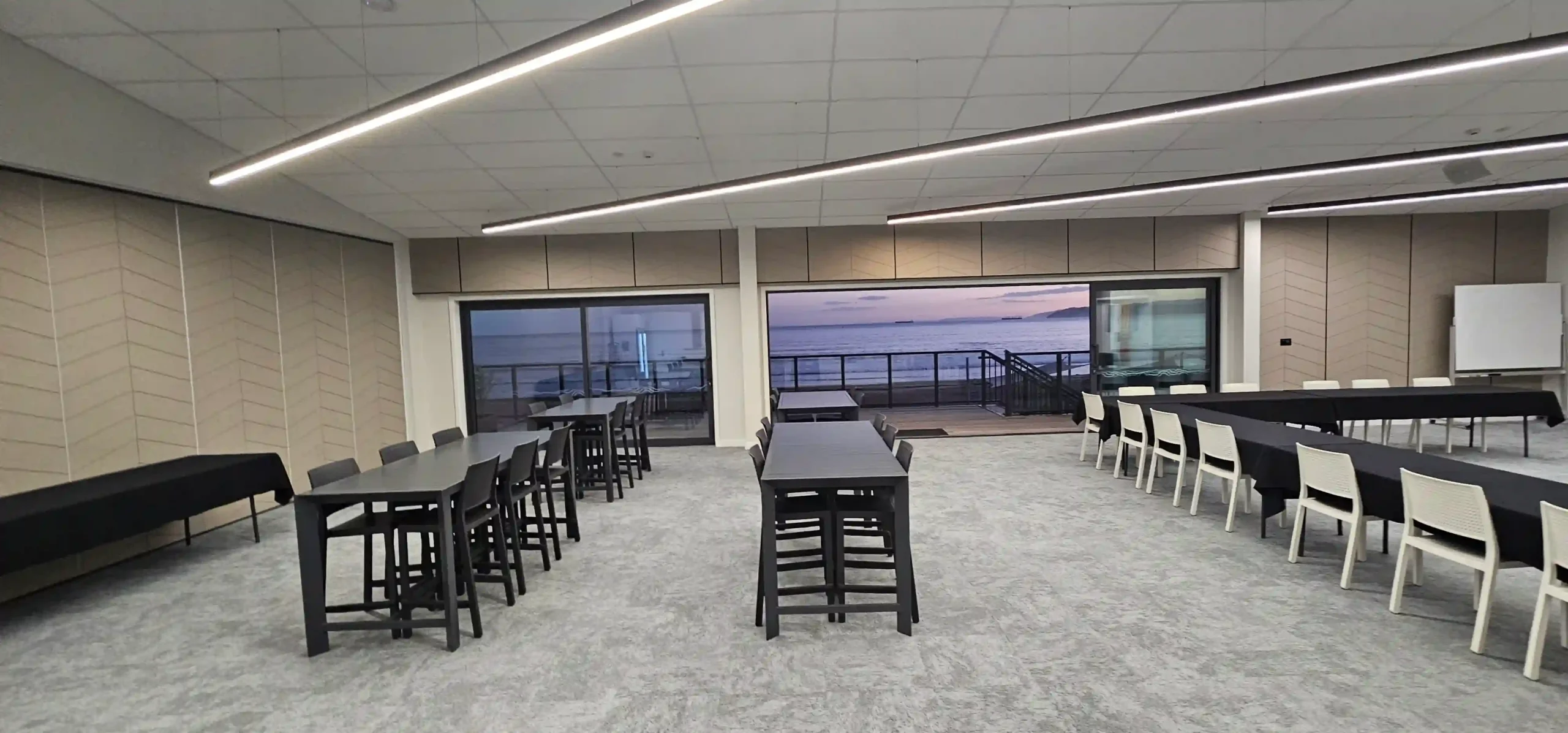
Cocktail-style layout in the Mana Moana Lounge with sunset views over Midway Beach
What Should You Ask About Capacity and Layout?
Ask for the maximum capacity in the specific layout you need. A room that fits 120 cocktail-style might only seat 60 banquet. If a venue gives you one number without asking about your setup, that’s your first red flag.
1. What’s the maximum capacity for my layout?
Every venue quotes capacity differently. Some give you the absolute maximum, standing room only, wall to wall. That number is useless for a sit-down dinner.
|
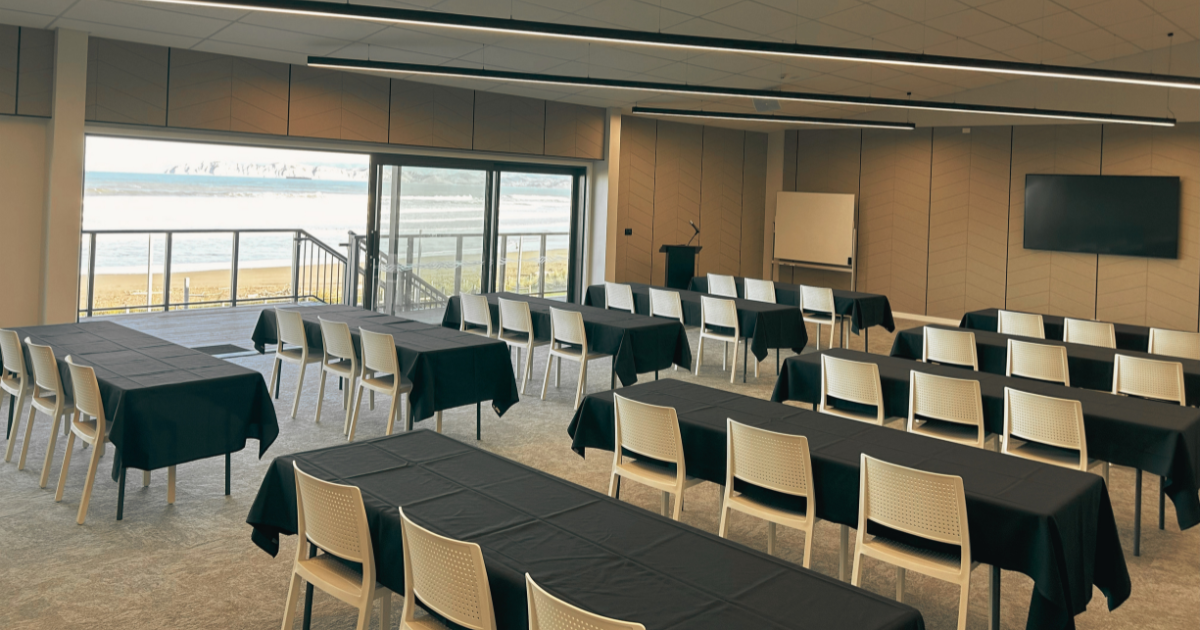
Ask for capacity by layout type: banquet rounds, long tables, theatre rows, U-shape, or cocktail standing. At our Mana Moana Lounge, for example, the room fits 140 cocktail-style but only 100 seated at round tables. That’s a 40-person difference from the same room. Red flag: A venue that says “up to 200” without asking what kind of event you’re running. |
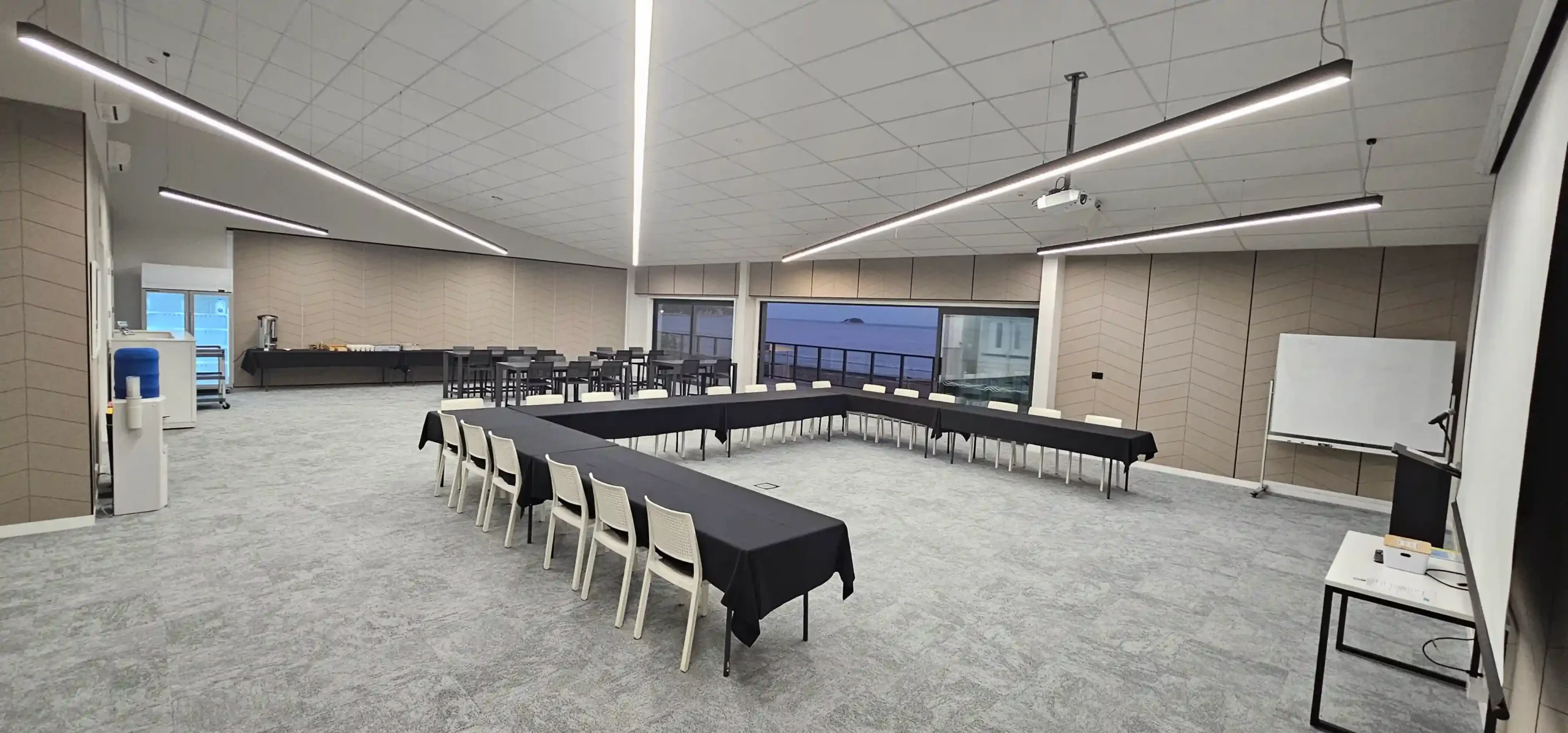
U-shape conference layout in the Mana Moana Lounge |
2. Can the room be configured differently?
Some venues lock you into one layout. Others have modular furniture that adapts. Ask whether you can adjust the setup. Ask who does the setup and whether there’s an extra charge for it.
Red flag: “We’ll set it up for you” with no mention of what configurations are available.
3. Is there a separate area for registration, breakout, or a bar?
For conferences and larger events, you need more than just the main room. Ask about foyer space, outdoor areas, and whether breakout rooms are available. A venue that can only offer one room limits what you can do with your programme.
What’s Actually Included in the Venue Hire Price?
Get a written list of what’s included and what’s extra. The base hire fee can mean anything from an empty room with power to a fully set-up space with linen and AV. If two venues quote you $500 and $1,200, the cheaper one might cost more once you add everything up.
4. What does the base hire fee include?
Ask specifically about: tables, chairs, linen, setup and packdown time, AV equipment, kitchen access, and cleaning. Some venues include all of this. Others charge separately for every item.
Get the full price list in writing. “We can sort that out closer to the date” is not good enough.
Red flag: No printed pricing or an unwillingness to put costs in writing before you commit.
5. Are there any additional fees I should know about?
Hidden costs are the number one complaint we hear from people who’ve booked other venues. Common extras that catch people out:
- Cleaning fee (sometimes $200-$500 on top of hire)
- Security bond or damage deposit ($500-$2,000)
- Overtime charges if your event runs late
- Corkage fee for BYO drinks
- Public liability insurance (if the venue requires you to hold your own)
Ask for the total cost, not just the hire fee. A good venue will give you this upfront without you having to dig for it.
6. Is there a minimum spend requirement?
Some venues, particularly those with in-house catering, require you to spend a minimum amount on food and drinks. This can range from $2,000 to $15,000+ depending on the venue and the day of the week. If you’re planning a smaller event, a minimum spend can blow your budget.
Red flag: A minimum spend that the venue won’t confirm until after you’ve paid a deposit.
What Are the Catering and BYO Rules?
Ask whether you can bring your own caterer, whether there’s a commercial kitchen on site, and what the liquor rules are. Catering is usually the biggest line item after venue hire, and the rules vary wildly between venues.
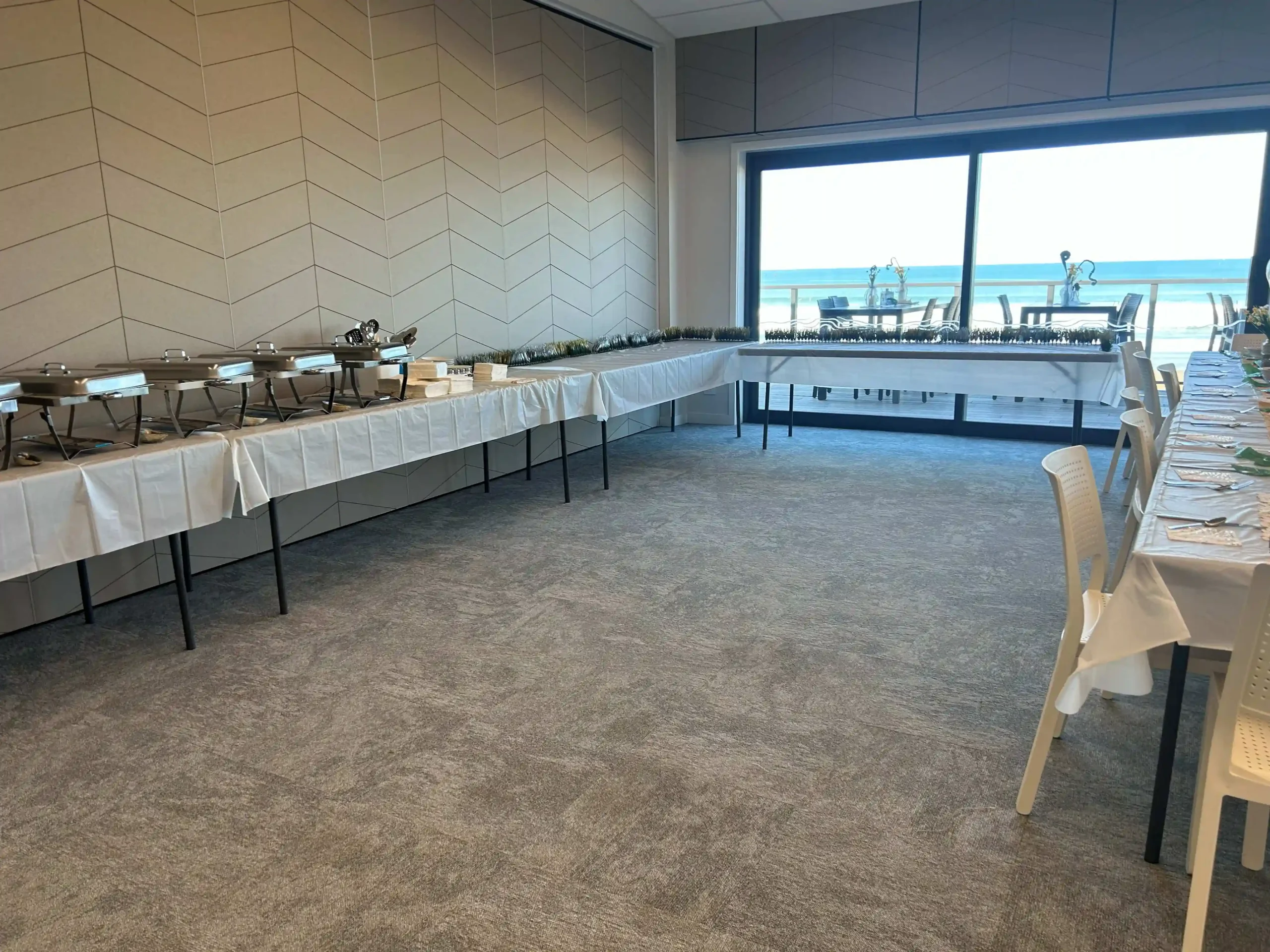
Buffet catering setup in the Mana Moana Lounge BYO tip: A BYO venue gives you flexibility on price and menu. An in-house catering venue simplifies logistics. The question is which model fits your event and your budget. |
7. Can I bring my own caterer or food? Some venues are BYO-friendly and let you hire any caterer you want. Others require you to use their in-house catering or choose from an approved list. Neither is automatically better, but you need to know before you budget. At Midway Hub, we’re a self-catering venue. You choose your own caterer, which keeps our hire rates lower and gives you full control over the menu. Red flag: Being told you “must” use their caterer with no alternative, especially if catering pricing isn’t available upfront. |
8. Is there kitchen access and what’s in it?
If you’re using an external caterer, they’ll need somewhere to prep, plate, and store food. Ask whether the venue has a commercial kitchen, a servery, or just a domestic kitchen. Ask about fridge and freezer space, bench space, and whether there’s a dishwasher.
A caterer working out of a tiny kitchen with one bench and no fridge is going to struggle. And that affects your guests’ experience.
9. What are the alcohol and liquor licence rules?
This one trips people up. Ask whether the venue holds a liquor licence or whether you need to arrange your own. If you’re bringing your own drinks, ask about corkage fees, whether there are any restrictions, and who’s responsible for managing alcohol service.
In New Zealand, if alcohol is sold or supplied at an event, someone needs to hold the appropriate licence. The venue might cover this, or the responsibility might fall on you. Get it in writing.
Red flag: Vague answers about alcohol rules. If nobody can tell you who holds the licence, walk away.
What AV and Technology Is Available?
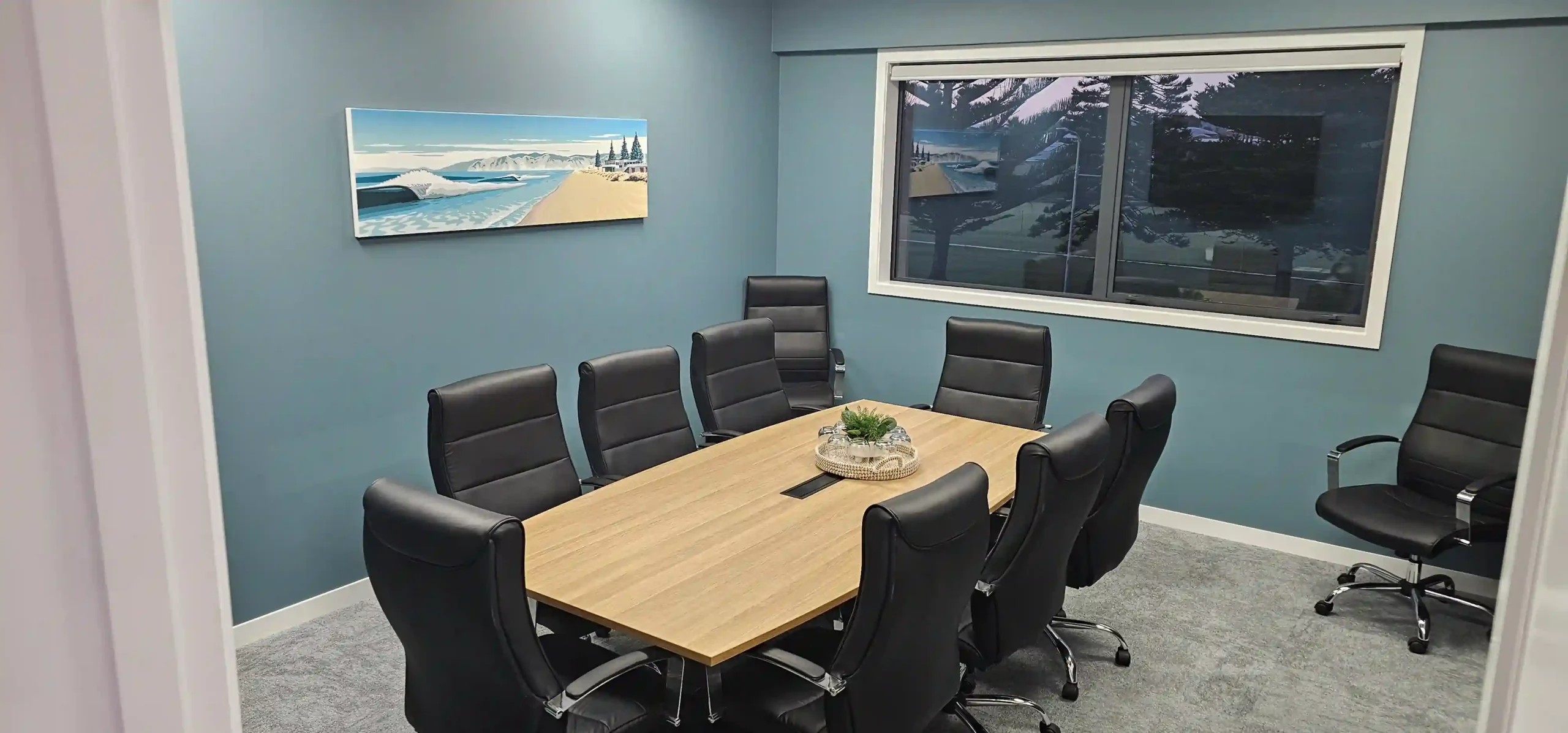
The boardroom at Midway Hub with display screen and natural light |
10. What audio-visual equipment is included? Ask about the specific kit: projector, screen, speakers, microphones (lapel and handheld), Wi-Fi speed, and display screens. “We have AV” means nothing. Get the list. For corporate events and conferences, this is make-or-break. Presenters who can’t connect their laptop, speakers that buzz, or Wi-Fi that drops out during a live stream will define your event for all the wrong reasons. |
11. Who sets up the AV and is there tech support on the day?
Some venues provide a tech person who runs the gear and troubleshoots. Others hand you a remote and wish you luck. Ask which it is. And if you’re bringing your own AV company, ask about power outlets, cable runs, and rigging points.
Red flag: “The projector is in the cupboard, just help yourself.” If there’s no one to call when something stops working, plan for it.
12. Is there reliable Wi-Fi and what’s the speed?
Free Wi-Fi sounds good until 80 people connect and the speed drops to nothing. Ask how many simultaneous users the network supports. For events with live streaming, video calls, or audience polling, ask about upload speed specifically.
How Does Parking and Access Work?
13. How many car parks are on site?
Sounds basic. But if your event has 100 guests and the venue has 30 car parks, you’ve got a problem. Ask about on-site parking numbers, any overflow parking nearby, and whether there’s street parking available.
For venues in busy areas, also ask whether parking is free or paid, and whether the venue has an arrangement with any nearby car parks.
14. Is the venue accessible for people with disabilities?
Check for wheelchair access, accessible toilets, step-free entry, and lift access if the venue is multi-level. If the venue says “we’re accessible” but can’t confirm specifics, that’s not good enough.
Your guests shouldn’t have to call ahead to find out whether they can get through the door. Every venue should be able to answer this clearly.
Red flag: Hesitation or “we haven’t had anyone ask before.” That tells you everything.
15. What are the bump-in and bump-out times?
Bump-in is when you and your suppliers can access the venue to set up. Bump-out is when everything has to be cleared. These times directly affect your event timeline and your supplier costs.
If your event starts at 6pm but you only get access at 4pm, that’s tight for a caterer, florist, and AV team to set up. Ask whether you can get earlier access and what it costs.
What Does the Contract and Cancellation Policy Cover?
Never book a venue without a written contract. It should cover the total cost, deposit terms, cancellation timeline, and what happens if something goes wrong on either side. Under New Zealand’s Consumer Guarantees Act, venue hire counts as a service, and the venue must deliver it with reasonable care and skill.
16. Is there a written contract or hire agreement?
If a venue doesn’t give you a written agreement, don’t book. Full stop. A venue hire agreement should clearly outline which spaces you’re hiring, the date and times, the total cost, what’s included, and both parties’ responsibilities.
Verbal agreements are almost impossible to enforce. If something goes wrong, you’ll have nothing to fall back on.
Red flag: “We don’t usually do contracts for smaller events.” Every booking needs one, regardless of size.
17. What’s the cancellation and refund policy?
Ask what happens if you need to cancel. Specifically:
- How much notice do you need to give for a full refund?
- Is the deposit refundable at any stage?
- What percentage do you lose at 30, 60, or 90 days out?
- Is there a force majeure clause covering events outside your control?
A reasonable cancellation policy has a sliding scale. The closer to the event, the more you forfeit. But you should know the exact terms before you pay anything.
Under NZ contract law, if the venue can’t deliver what was agreed, you have rights. But those rights are much easier to exercise when everything’s in writing.
Red flag: No written cancellation policy, or a policy that says “deposits are non-refundable under any circumstances.”
Do You Need Insurance and Who’s Liable?
18. Does the venue have public liability insurance?
Most commercial venues carry public liability insurance. But “most” isn’t “all.” Ask to see proof of their cover. If a guest trips on a loose cable or a shelf falls, you need to know who’s responsible.
19. Do I need my own event insurance?
Some venues require hirers to hold their own public liability insurance, typically $1-2 million cover. If you don’t have it, you can usually get single-event cover for $100-$300 through an insurance broker.
Ask the venue whether this is required, what level of cover they need, and when you need to provide proof. Don’t leave this to the last week.
| Insurance Question | What to Ask | Good Answer | Red Flag |
|---|---|---|---|
| Venue’s own cover | “Do you hold public liability insurance?” | “Yes, here’s our certificate” | “We’re covered, trust us” |
| Your responsibility | “Do I need my own insurance?” | Clear yes/no with specifics | “We’re not sure, probably not” |
| Damage bond | “Is there a security deposit?” | Set amount with clear refund terms | Unclear amount or vague refund process |
Red flag: A venue that won’t confirm their own insurance status. That’s a deal-breaker.
What Questions Do Most People Forget to Ask?
These are the ones that cause problems two weeks before your event. We hear about them all the time.
20. Is there a noise curfew or volume restriction?
Venues in residential areas often have noise restrictions. Music might need to stop by 10pm, 10:30pm, or midnight depending on the local council rules and the venue’s resource consent. If you’re planning a late event with a DJ or live band, ask this before everything else.
What about exclusive use vs shared bookings?
Larger venues sometimes book multiple events on the same day. Ask whether your booking gives you exclusive use of the space, or whether another group might be in an adjacent room. For weddings and private celebrations, this matters a lot.
Is there a wet-weather backup plan?
If your event involves any outdoor element – a ceremony on the deck, drinks on the lawn, photos by the beach – ask what happens if it rains. Does the venue have an indoor space that can absorb the outdoor component? Or are you on your own? Weather is one of the <a href=”/event-planning-problems/”>10 most common event planning problems</a> and catches organisers out every summer.
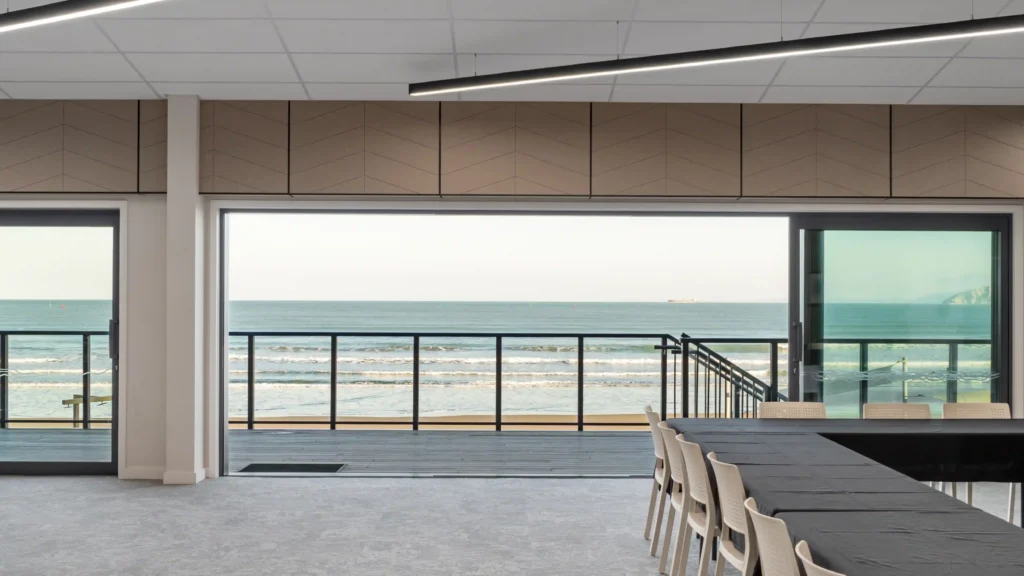
At Midway Hub, our deck overlooks Midway Beach. But if the weather turns, the Mana Moana Lounge has floor-to-ceiling windows that give you the ocean view without the wind.
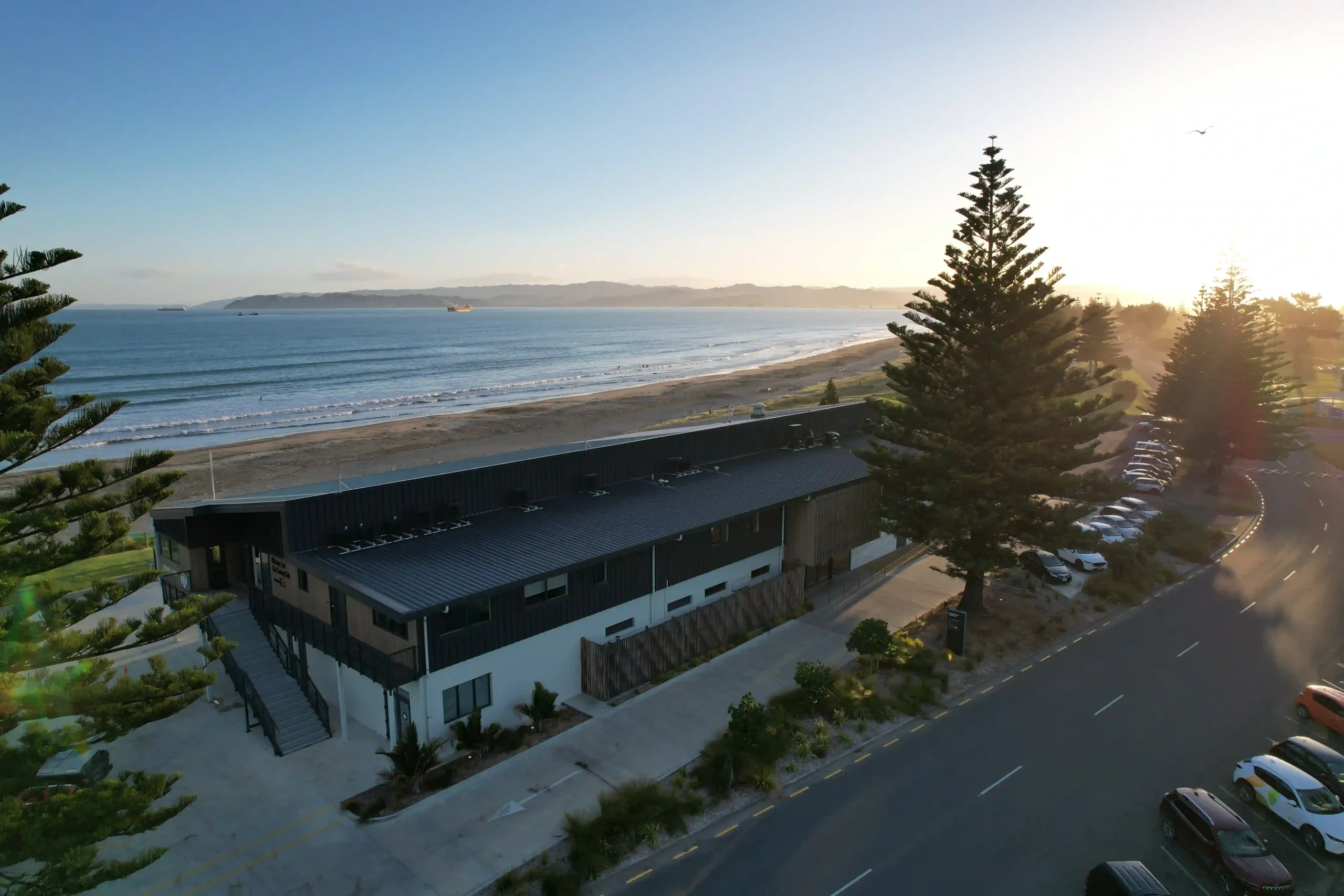
Aerial view of Midway Hub on Midway Beach, Gisborne
Who is the day-of contact?
This is the one almost nobody asks. On the day of your event, who do you call if the lights aren’t working, the door is locked, or the heating won’t turn on? Get a name and a mobile number. “Call the office” doesn’t help at 7am on a Saturday.
Book With Confidence, Not Assumptions
Three things to take from this list:
- Get everything in writing. If a venue won’t put their pricing, inclusions, and cancellation terms on paper, find one that will.
- Ask about the things that don’t show up on a tour. Insurance, noise curfews, bump-in times, and day-of contacts matter more than the colour of the tablecloths.
- A good venue welcomes these questions. If asking about cancellation policies or insurance makes a venue manager uncomfortable, that tells you something.
We answer all 20 of these questions on our venue hire FAQ page and in every site tour at Midway Hub. If you’d like to see how our spaces stack up, get in touch to book a tour.
Frequently Asked Questions
How many questions should you ask before booking a venue?
Ask at least 15-20 questions covering capacity, pricing, catering, AV, cancellation, insurance, and logistics. The more you ask upfront, the fewer surprises you’ll deal with later. Our full list of 20 venue booking questions covers every category.
What should be included in a venue hire agreement in NZ?
A venue hire agreement should include the spaces being hired, dates and times, total cost with itemised extras, deposit and payment terms, cancellation policy, insurance requirements, and both parties’ responsibilities. Under NZ law, venue hire is covered by the Consumer Guarantees Act, which requires services to be delivered with reasonable care and skill.
Do I need event insurance to hire a venue in NZ?
Many venues require hirers to hold public liability insurance, typically $1-2 million cover. You can get single-event cover for about $100-$300 through an insurance broker. Ask the venue what level of cover they need and when you need to provide proof. Check the details on our venue hire FAQ page for more.
What’s a reasonable deposit for venue hire in NZ?
Most NZ venues charge a deposit of 25-50% of the total hire cost, due at the time of booking. A security or damage bond of $500-$2,000 is also common and should be refundable provided no damage occurs. Always get the deposit terms in writing as part of the venue hire agreement. For more pricing context, read our guide to venue hire costs in Gisborne.
Can I bring my own caterer to a hired venue?
It depends on the venue. BYO or “dry hire” venues let you choose any caterer. Others require in-house catering or offer an approved supplier list. At Midway Hub, we’re a self-catering venue where you pick your own caterer and use our servery and kitchen facilities. Browse our venue hire options to see what’s included.